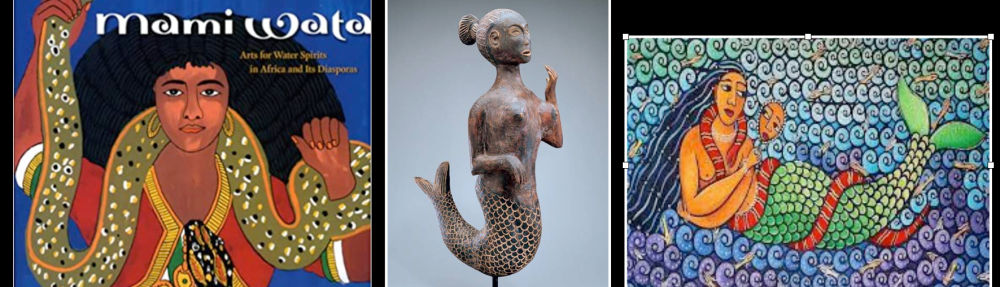
Within the Section of “African Mermaids and Other Water Spirits” we are told that the Water spirits of Africa are “far from being relics of the distant past…” and rather continue to be “strikingly relevant to those who believe in them.” Through this, the author dismantles the belief that myths and legends are not just history to be repeated, but that history is a concept that is continuing to be created.
The stories regarding African Gods and Goddesses bear striking resemblance to the tale associated with the Greeks or Romans. The mythical beings responsible for overseeing different domains, the balance of everything that is and ever will be on Earth. In observance, as we see how the centuries have gone on and people have moved from plain to plain, the legends have become lost, unused, and lacking in relevance in modern times. And yet – the same can not be said for these spirits and Gods of African culture. The connection between “real life” and fantasy is a thin veil crossed in these regions. Natives report sightings of aquatic monsters, visions we have only dreamed or read about, appearing in the wild. They halt research and construction. They are responsible for the ill-doings of man.
This relationship between the marine spirits of the domain and human kind continues to be explored by African communities. While we in the Western hemisphere have moved away from the unknown of myths and fantasy, the peoples of these nations have stable and strong connections with the Gods and Goddesses from the worlds of their long – ago ancestors. Their presence is not a sign of a new age, a revelation – but rather a sign of a faith remaining stable in a developing world away from legends. A fight to recognize what has always been in front of us, even if we choose to ignore what we do not wish to see. These communities do not run from these encounters, yet speak of them as if they were true. These spirits are integrated into their everyday lives and language, connected to an aquatic world many of us have forgotten.
This is a wonderful argument about the difference between the western and African mermaid stories as being less about their content and more about how they continue to be used and viewed: ‘While we in the Western hemisphere have moved away from the unknown of myths and fantasy, the peoples of these nations have stable and strong connections with the Gods and Goddesses from the worlds of their long – ago ancestors. Their presence is not a sign of a new age, a revelation – but rather a sign of a faith remaining stable in a developing world away from legends. A fight to recognize what has always been in front of us, even if we choose to ignore what we do not wish to see. ”
Your argument also taps into our discussions of the ocean– from blue, humanities and ocean with a O two Derek Walcott’s poem “The sea as history.” You I definitely understanding that perspective and orientation shapes what we can see… and what we miss. This
Emily I love that you also saw this connection between this introduction of these water deities as part of the development of the world as we know it, how they uphold our society without us ever knowing it. They embrace this reality of not having control in a way we never do; we refuse to relinquish control to anything that could actually be on “our” territory and more powerful than us, instead we run from these ideas the way you pointed out. It is these folkloric societies and traditions upheld that can actually recognize it, and flourish as a result of it, while we continue to decline in our inability to act in cohesion with nature.