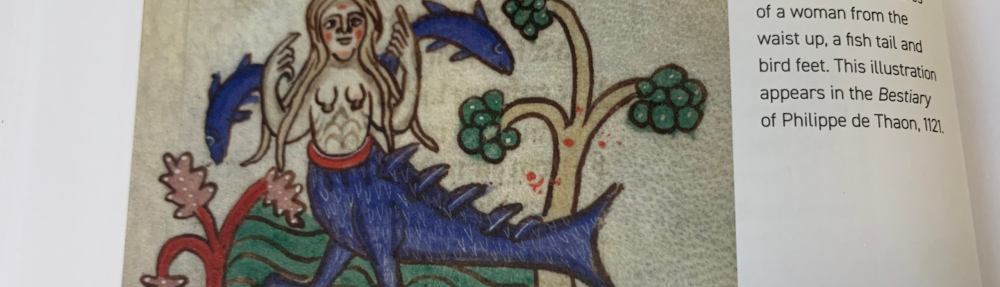
What caught my eye was the beginning of “Their Bodies, Our Anxieties,” where it discusses how we prefer our world to be well-ordered and sharply defined in categories, but it highlights the similarities between hybrid monsters and humans. They’re able to eat, sleep, and breathe like us, but seemingly hold enough distinctions for us to shy away from them. This reminded me of some recent trends in horror since at least 2014, where we take what was ‘safe,’ for example, a children’s mascot, and proceed to make it monstrous in a subtle way, for example, having the mascot act irregularly hostile towards children when it shouldn’t be. It adds to the uncanny anxiety we feel towards the subject, but it also fascinates people, myself included, as mermaids, or at least their early versions, don’t seem all that harmful. Then later, they’re made out to be temptresses whose goal is to lead men astray and consume them. When reading about the part where the text talks about the beauty of a mermaid, it got me thinking about how both halves of a mermaid show our odd interest in the known and unknown. The upper half is what we’re used to and can recognize as distinctly normal; this carries on with the lower half too, as our brains can recognize that it’s a fish. But when you put it all together, what is ‘known’ becomes a fearful yet interesting ‘unknown.’ We can recognize its not a natural thing for a woman’s upper half to be conjoined to a fish lower half, however, it still has that ‘harmless’ feel allowing later interceptions to add unsetting traits that would attract both fear AND attention. It’s interesting to know what looks harmless to us might be the most dangerous thing in the room, and it isn’t solely a modern trend but has been going on for centuries.
Mermaids: Literature & the Environment
ECL 305. Fall 2025. Professor Pressman
I found it very interesting that the stories that were child centeric and are used to answer many of the creations around them and provide a entertaining way to interpet the orgins of the things around them.