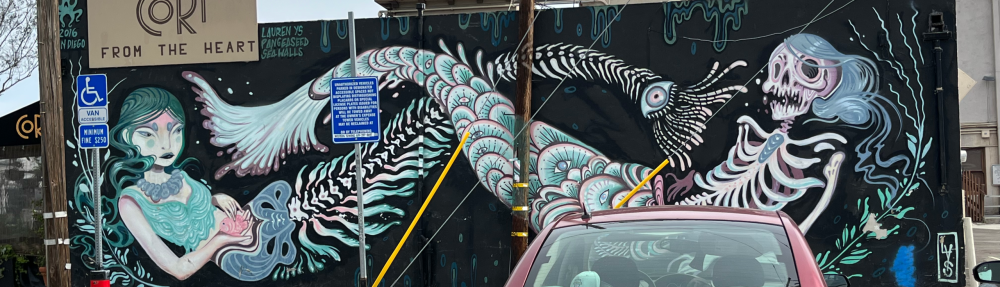
While reading the “Legend of Melusina” from The Penguin Book of Mermaids, something that stood out to me was the theme of duality and hybridity. Specifically, what piqued my interest was the idea that, despite Melusina being “a serpent…from the waist downwards” (87) who can inflict harm, she is also depicted as being a doting wife who builds an empire for her husband. By creating this paradoxical characterization, the author forces readers to contend with the idea that although Melusina is this “supernatural” creature who is capable of damage, she is not an inherently evil being – showcasing the idea that women are multi-faceted.
At the beginning of the story, we are shown that Melusina “conceived the design of being revenged on [her father]” (87) after he had violated his wife’s privacy and trust. In turn, this results in a curse that forces Melusina to become part serpent on Saturdays as punishment for her crimes (87). This aligns with the nefarious characterization of hybrid creatures that most readers are accustomed to reading about. She is posited as a trickster to highlight that there is still this “deviant” nature within her as a result of being part human and part otherworldly. Starting the story with this dangerous characterization allows the reader to play into their biases so that the later actions of Melusina illuminate her complexity.
However, we are then shown that Melusina has the capacity to be what is considered a “good” wife to her husband and help him succeed since “Out of her great wealth, she built for him… the castle of Lusignan” (88) and other properties. Rather than simply keep the wealth for herself, she used it to help build him up and elevate his status in society. The author shows us that she has the capacity to care for Raymond and their family, which goes against the previous notion of her “untrustworthiness.” The opposing characterization helps rethink the notion that simply because a being is a hybrid, there is something inherently wrong with their disposition. In spite of Melusina having what some would deem “dangerous” characteristics, it does not mean she can’t possess the ability to be loving and caring.
Much like women in real life, Melusina illustrates how women can have many characteristics and qualities. Illustrating Melusina as a complex being allows readers to move past the idea that both women and hybrid creatures are essentially “one size fits all.” The duality that Melusina possesses can be seen in all women since they are made up of a multitude of aspects. To say that all women or supernatural beings possess a limited set of characteristics would be to ignore the complexities that they both experience. Therefore, the story empowers readers to see the duality that can exist in an entity instead of seeing it as a rigid being.
Great set-up here. You build towards a claim: “The opposing characterization helps rethink the notion that simply because a being is a hybrid, there is something inherently wrong with their disposition. In spite of Melusina having what some would deem “dangerous” characteristics, it does not mean she can’t possess the ability to be loving and caring.” Before you jump to the present day, can you stay with your insights a bit more and push this claim towards a WHY/SO WHAT? Why does the story do what you say it does? Why is this important to see?
Hi Kelly!
I really appreciate your nuanced read into Melusina. Though I didn’t focus on this for my blog post, I do find often that the supernatural and “otherness” are seen as something to be feared or weary of. What would happen for women and those that are marginalized in our society and in our stories if this “otherness” is viewed in the light in which you put it? People who are not just something that goes against a norm, but complex people who have flaws and strengths.