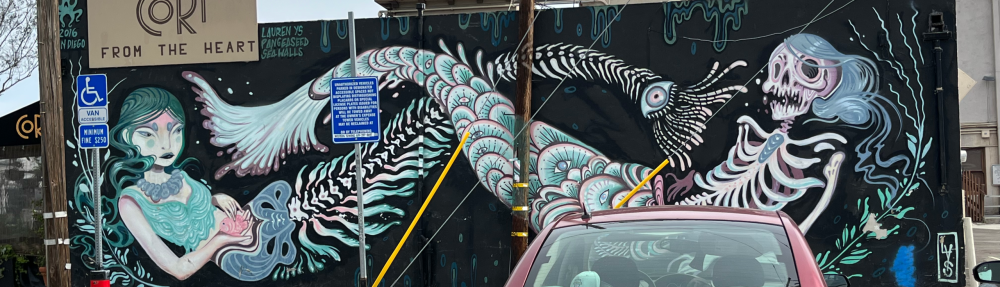
All humans are separated by land: continents, countries, and regions. We came up with this idea of imaginary lines that separate us from wars fought long before many of us can remember. For example, California declared independence from Mexico in 1846, then later became a U.S. State after signing the Treaty of Guadalupe Hidalgo in 1948. All of this to say, land separates us, but the oceans connect us. We are so focused on our disconnection from each other because of imaginary lines that we forget that this planet is 70% ocean, with scientists sometimes calling it the interconnected global ocean. Interconnected. And maybe, as Steve Mentz suggests in his “Deterritorializing Preface,” if we deterritorialize ourselves with terrestrial language, we can become interconnected as well, just like the oceans.
Mentz offers the readers seven different terrestrial words with seven different oceanic replacements: field becomes current, ground becomes water, progress becomes flow, state becomes ship, landscape becomes seascape, clarity becomes distortion, and horizon becomes horizon (Mentz xv-xvii). These are just a few examples in which we can detach ourselves from land-bound vocabulary, but I wonder if taking this a step further (or, as Mentz might suggest, deeper) could help humans stop having such polarizing views ion each other. If humans were to deterritorialize themselves, not just through a means of language, but as a means of differentiation across peoples, could we be one step closer to harmony?
Mentz concludes with this bit of wisdom: “The blue humanities name an ocean-infused way to reframe our shared cultural history. Breaking up the Anthropocene means reimagining the anthropogenic signatures of today’s climactic disasters as a dynamic openings as well as catastrophic ruptures” (xviii). I note how Mentz writes, “shared cultural history,” as if every person on this earth shares cultural history with each other. Which, he’s not wrong—there is one thing that connects us all, no matter what imaginary lines we draw: the ocean. So perhaps, if we take a cue from Mentz, we might finally begin to find a sense of harmony between each other.
This is a beautiful and brilliant post. You nicely build interpretation from the text, grounding your insights in the writing, but developing your own sense of meaning and So What. I am eager to have you engage with Mentz and might even send him this blog post to show the relevance and impact of his work. Wonderful!
Hi Annie, I really enjoyed your post on deteritorializing our vocabulary, especially in critique of the imaginary borders we have built between ourselves. The way our language grounds a strict binary of connected and disconnected, as if, through your example, California’s decision to “separate” itself from Mexico suddenly created a deep and impassable border across the land. However, just as you noted, we are connected through many water ways, the ocean, the Gulf, and the rivers in between. It reminds me of the human resilience of crossing, and passing between worlds and imaginary lines drawn on maps and policed by the state. Also, I think there is a beneficial merit in trying to broaden our language to fluid concepts. By understanding that like a ship caught out on the sea, we own nothing, and control nothing of the natural world. We must work with the flow and current, instead of against it. To me, that includes removing the boundaries and rules that separate humans from connecting.