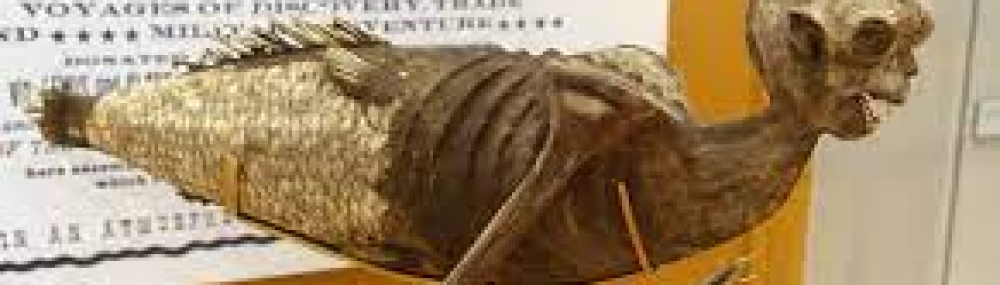
It is almost like Cristina Bacchilega and Maria Alohalani Brown read my mind from last week. In their Introduction chapter of The Penguin Book of Mermaids, Bacchilega and Alohalani Brown write, “There is something deeply unsettling about a being whose form merges with the non-human. Whether they dwell in fresh or salt water, aquatic humanoids raise questions about what it is to be human and what lies beyond a human-centered world. Physically, they are both like and unlike us” (xi). This is something I touched on last week in my blog post, focusing on how Scribner observes the human interest in hybridity. Here, in Bacchilega and Alohalani Brown’s introduction, they agree with Scribner’s astute observation on hybridity, putting more of an emphasis on how, not only are we interested in the mermaid’s hybridity, but we are astonished, and, in a deeper sense, somewhat unsettled because of this merging with the familiar and unfamiliar.
Bacchilega and Alohalani Brown go on to say, “We humans do not deal well with betwixt and between—liminality makes us anxious. We prefer our world organized into well-ordered and sharply defined categories, and we prefer to be in charge of it. Nonetheless, we are strangely drawn to the other, who is in part a mirror image of us and appears within reach, even if mentally ungraspable” (xi). While, yes, the hybridity of the mermaid—and other mythological creatures, for that matter—does make us uneasy most of the time, it is the peculiarity and similarity that draw us to the mermaid.
Humans have, and likely always will be, drawn to mermaids. Whether it is their similarity or difference to us, there is something so alluring about their mix with something we know of (separately, a human and a fish). But together, we still get this uncanney-valley-like feeling when we think about mermaids. They are like us from the waist-up, but from the waist-down, they are something completely different. We like to be in control, according to Bacchilega and Alohalani Brown, but also, we are “drawn to the other” (xi). This fascination will never die, as long as we crave something otherworldly and unlike our natural world.
Hi Annie!
The idea of the uncanny valley significantly influences how humans react to mermaids. It is interesting to observe how perceptions of mermaids have evolved, from mermaids looking like a human being consumed by a fish to half-human, half-fish. Over time, humans have changed the look of the mermaid to fit into our comfort zone, which may be a cause of why the mermaid became a beautiful, docile creature.
Hi Annie! I think we are not only drawn to them, but JEALOUS of them. We are so jealous of their freedom, their duality, their ability to exist between two worlds, while we “prefer our world organized.” I think mermaids, and our love for them, is a testament to the human dislike of binaries and “organization.” I personally hate being in control, or rather under control, and our human systems, (of patriarchal influence) keep us from moving through life at a fluid and personal pace. But the mermaid (or merperson), on the other hand, is free. They are intune with nature, they don’t move against the ocean, as no creature truly can, but with it, in full embrace of the chaos.
This!!!! I am becoming more and more convinced that a major component of the prevalence of mermaids is our “jealousy” of them. “they don’t move against the ocean, as no creature truly can, but with it, in full embrace of the chaos” You naiiiiiled it. 🫰🫰🫰🫰🫰🫰🫰
This was a very interesting blog post for me, in particular the quote you used “We humans do not deal well with betwixt and between—liminality makes us anxious” as it plays into my very own fear of the deep ocean due to potential unknown. However, I am also deeply allured to the beauty the ocean has to provide which in its own is a parallel to your comparison of our inherit fascination with mermaids.
Hello Annie! Great post on the innate human desire to explore what is simultaneously familiar and unfamiliar to us. I’ve never heard the term “Uncanny Valley” be used in the context of a mermaid, I usually hear it when talking about a computer generated being resembling an almost human figure. I think in modern times most people look at mermaids with awe because most people believe them to be fantastical creatures, whereas the people in history would get more of that eerie feeling when looking at the sculpted mermaids.