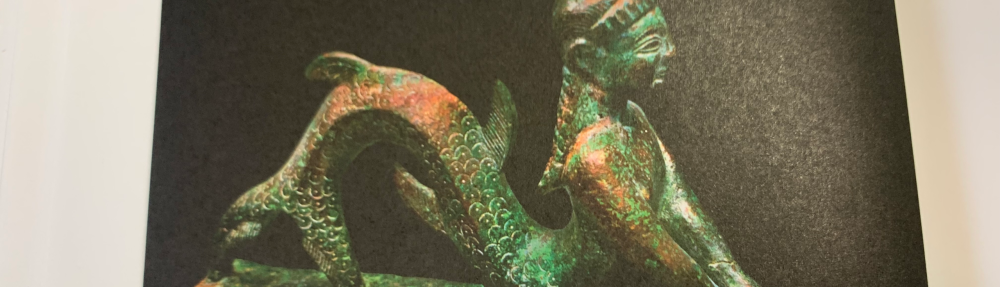
The classification of mermaids as monsters rather than mythological creatures has a lot to do with variation in perception of women. The introduction discusses the existence of all hybrid creatures in ancient literature as being seen as both cautionary and also exciting. When it comes to creatures like unicorns, their fantastical existence made them a staple for children, versus centaurs seen as freaks of nature for their unnatural mesh between human and horse. Horses natural undesirability as animals made them something humans would never want to be associated with, versus unicorns being entirely one species with these concepts understood as beautiful attached to them.
The human half of mermaids reflects the almost selfish view people tend to have; if it’s not happening to us, we cannot begin to understand it. When we don’t understand, it arises fear and these representations become “monsters” because of their inability to relate to the experiences that only our brain actualizes. Their non-human existence and how its impacted by the environment becomes imminent for us to be able to place ourselves in the aquatic world, in the real world that fish and other animals suffer in as a result of the incredible issues facing the ocean as climate change worsens.
In the same light as centaurs and unicorns, but alternate views, mermaids original beginning as mermen allowed them much more freedom to be seen as powerful and forces of nature. Following that, artistic interpretations skewed the eventual Greek creation of mermaids as Triton’s wife became more of an additive than a standalone character, and made mermaids a reflection of these sexualized ideals of women. Religion then utilizing these characters to squash any of humanity’s belief in femininity’s benefit, painting them as lustful creatures who intended to bring humanity’s destruction, thereby added to the mountain of rhetoric against womanhood.
Their eventual sexualization additionally has to do with this societal perception when it comes to women, and how femininity immediately signifies a difference in the subject at hand. Going from mermen that focused on anything but their beauty and stories of Triton to women seducing men and glorious creatures trivialized them to the standards women must comply to . It creates the conclusion that regardless of being seen as monsters, they will always be considered women above it, and that’s their actual issue.
Whoaaaa you are bringing up great points. I love the comparison of centaurs to unicorns.
Hi Kenzy,
I agree with your statement where you said, “The human half of mermaids reflects the almost selfish view people tend to have; if it’s not happening to us we cannot begin to understand it.” This stuck out to me because in society today it is very true that most people only care about what happens to them and how they are affected, rather than what may happen to a group or people they dissociate with. We have to realize that other people can always be going through things, and that we need to be there for them even if it does not directly affect us.