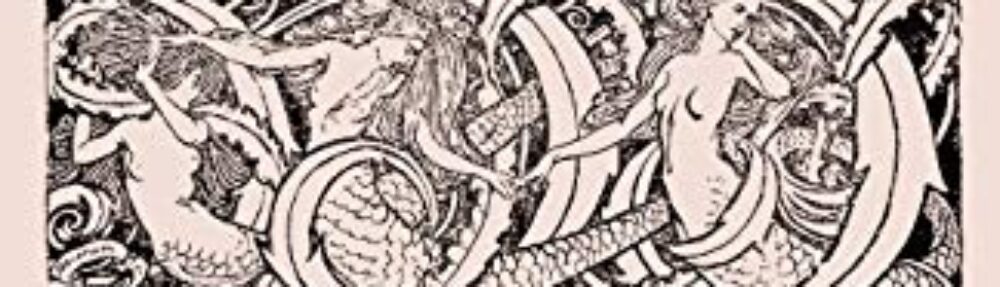
In the section titled “African Mermaids and Other Water Spirits” from The Penguin Book of Mermaids, the authors highlight the idea that these water spirits are part of a long history and become a way to learn more about African culture. By looking to water spirits as a way of gaining knowledge about a community, it de-centers the Eurocentric view of learning as something that has to be scientific and come from a traditional historical account.
What stood out to me specifically was the description of the Yoruba people of West Africa and that “When the Yoruba peoples were captured during the transatlantic slave trade, they brought their worship of Yemoja [the water deity] with them” (Penguin 166). Rather than simply seeing the water deity Yemoja as being “associated with family, women, motherhood, and the arts” (Penguin 166), she becomes interlaced within the pain and suffering that many of the Yoruba and West African peoples were subjected to by colonial powers. Her migration from West Africa across the Atlantic Ocean can then be seen as a testament to the forcible movement they faced as they kept the belief alive through the continuation of her memory for many generations. She essentially allowed them to keep their heritage and connection to the homeland during a time of increased stress and torment. Subsequently, Yemoja is a figure who provided comfort at a time when Yoruba people were being treated as if they were not human, and oftentimes did not have many ways to cope with the lack of humanity that they were given. By looking at Yemoja as not just a water spirit but as a chronicle and archive of the history of the Yoruba people, she becomes a historical figure that allows us to dive deeper into a narrative that is frequently silenced due to a lack of traditional historical knowledge.
Looking at water spirits as a method for learning about a culture is then significant because it moves away from a Eurocentric perspective that views history as something that is visible and concretely recorded. This moves mythologies away from a fictional realm and into a historical realm by acknowledging that these myths and beliefs are based in reality and come from lived experiences that are significant to a culture. We can then use these myths as a way to bridge the gap between a western account of history and those who are left out of those written and preserved accounts of events.
Hi Kelly,
I think you make a lot of great points about the de-centering of physical historical documentation from Western society, to the importance of other cultures way of learning and documenting history. As we talked about in class on Tuesday, history and story are often shaped by how they travel (literally and metaphorically) through the world and over the ocean. Even Western society history, as you pointed out, is affected by how and who tells story. Which is why it is important to, not only learn other countries histories but, learn history from a different perspective.