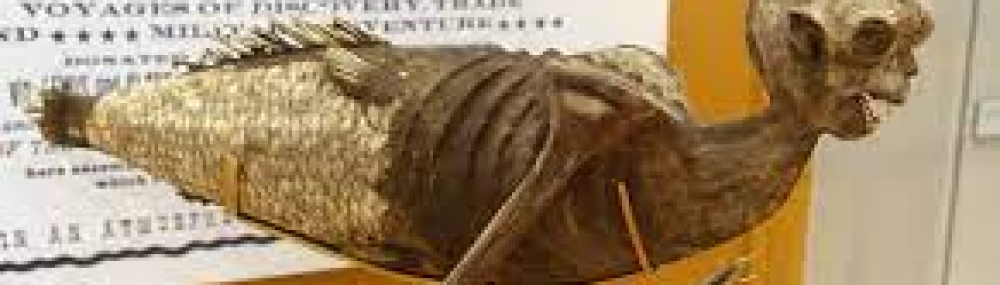
In Monsters, an anthology book compiled by Andrew Hoffman, I found a piece, “Mermaids’ Attributes, Behavior, and Environs,” written by Skye Alexander. In this passage, Alexander highlights the common themes that have been central to merpeople since their ancient beginnings, and why these traits make them so intriguing.
Alexander offers insights that would definitely enhance our understanding of merpeople and literature in the environment. She explains how certain merpeople traits, that we have learned about from age-old stories, make them more violent and dangerous than we have previously discussed. The narrative around Mermaids, in particular, is heavily based on their “enchanting voices, their sensuality, and their destructive behavior” (Alexander 1). We have spoken extensively in our discussions about these details and the physical traits of mermaids. We have discussed how their destructiveness had reason and rhyme, but at the end of the day, they were written to be lesson-bearing monsters. Although I do believe “monster” to be a somewhat neutral term in this class, as I am not afraid of mermaids or many other methodical creatures, nor do I think they are inherently “bad” or “evil”. Nonetheless, they do fit the part. This text has led me to the conclusion that the voice, song, or sound of mermaids is their truly “monstrous” trait, rather than their physical hybridity. As the only predominantly female monsters in our world, mermaids’ ability to kill with their voices speaks volumes about women and the way in which they are portrayed.
The fear associated with mermaids, more often than not, relates to their alluring songs and siren-like voices. Although their shape and animalistic features are mentioned and enchanting for sure, the most deadly aspect they possess is their sound. Unlike other monstrous creators whose large, hairy bodies or sharp teeth make them dangerous, mermaids don’t breathe fire or suck blood; they kill with their songs. Their enticing voices leave sailors, pirates, and all other seamen doomed. “Medolious but melievant temptatress – no man could resist their tantalizing singing” (Alexander 2). In many examples, the true fear of mermaids stems from their communication and the imminent drowning that it would cause. The Greek Sirens were dark and spiteful creatures with wicked intent to kill, possessing the superpower of sound. Although mermaids’ beauty and nudity may have caught the eyes of men, their ears were the weakness that these creatures preyed upon. In general, the deaths that mermaids caused were not necessarily brutal or graphic; instead, they lured men into a space they simply could not survive. They didn’t rip sailors’ hearts out or sink fangs into flesh. When necessary, their violence was channeled through the medium of aggressive waters. They have been credited with controlling the ocean in some way or another. “Many legends link mermaids with storms and even blame them for whipping up tempests at sea in order to sink ships” (Alexander 3). Their tunes or, in some cases, shrieks, like those of the ancient Irish banshees, are their weapon of choice.
While mermaids use their voices to take lives, their lack of voice and communication in stories like Hans Christian Andersen’s has also proven to work against them. He claims the songs of mermaids are to calm the sailors already bound for death. The Little Mermaid dealt away her tongue in pursuit of human legs and love, and it inevitably led to her death as she could no longer tell the prince she saved him or bring herself to kill him either. Here, her voice, or lack thereof, is not a weapon or tool of destruction but a sacrifice or form of payment. She was willing to be silenced forever, even if her voice was her greatest or most powerful quality, all to be human and escape the water.
This trope of voice and noise is particularly interesting when you factor in gender. Mermen have historically been rarely associated with singing. “Folklore remains pretty quiet on the subject of mermen’s singing ability” (Alexander 2). How come this singing motif is reserved only for mermaids? Their femaleness and their way of communicating (or killing) are directly linked. These early mermaid tales are from a time period where women were practically voiceless, politically, but also in the home. In a world run by men, women were meant to be fragile. They would not hit or scratch or be “unruly”. The second their words cut too deeply or were used too much and with too much volume, they were “hysterical.” In a world where you cannot legally own anything, including yourself, all you really have is your voice. It is so interesting to me, the dynamic of making a voice a weapon. “Psychologically, mermaids have been said to present the complexity of women’s emotions, ranging from playful to stormy” (Alexander 4). I consider it empowering to be acquainted with mermaids; they are beautifully powerful creatures free from the clutches of worldly patriarchy. This pride, however, is fogged by the seemly constant sexualization and demonization of these beings. Do women, and specifically young maids, lead to the downfall of men? Are we nothing more than long hair, breasts, mirrors, and combs? Are our voices shrill and headache-inducing? Mermaids, unlike other mythical monstrous, are driven by emotion and desire for connection; in a way, that’s what makes them so dangerous. So, as a woman with two legs and my feet on the ground, I can’t help but wonder if that same emotion also makes us dangerous to or different from men.
If song, sound, or speech is a mermaid’s sword and the very thing that makes her a monster, then ultimately, mermaids expose the societal fear of female power or expression. Cultural narratives have used monstrous mermaids as a tool to warn men of “crazy” women and keep us quiet. Luckily, in contrast, these stories have pulled a 180 in contemporary times. Serving as loveable monsters who have gone on to empower women and teach us a lesson or two about men. I, too, will make like a mermaid and use my voice as a tool.
Works cited:
Alexander, Skye. “Mermaids’ Attributes, Behavior, and Environs.” Monsters, 1st edition, edited by Andrew J. Hoffman, Bedford-St. Martin’s, 2025, pp. 232-237. A Bedford Spotlight Reader.